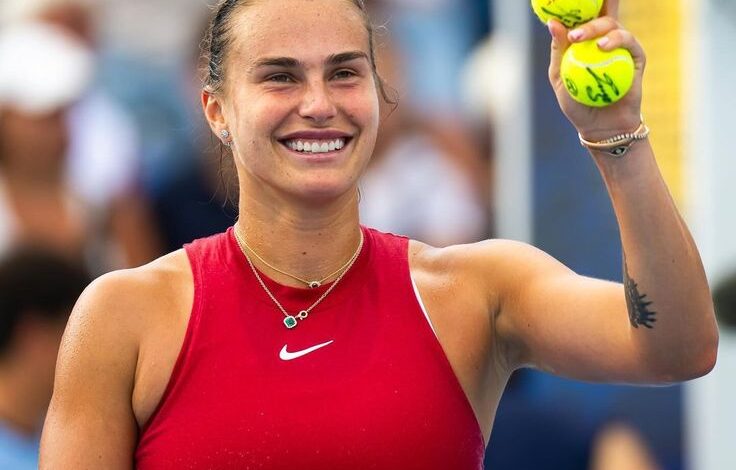
The roar of the Rod Laver Arena still echoes in her triumphs, but rewind to the summer of 2022, and Aryna Sabalenka was staring down a different kind of silence: the quiet despair of a career on the brink. The Belarusian powerhouse, now a three-time Grand Slam champion and the undisputed queen of the WTA baseline wars, teetered on the edge of quitting it all. Not because of a heartbreaking loss or geopolitical storm—though those battered her too—but over something her coach Jason Stacy now calls “ridiculous”: a serve that betrayed her at every turn, spiraling into 428 double faults for the year and a crisis of confidence that nearly ended her story before its greatest chapters.
Stacy, the high-performance guru who’s been in Sabalenka’s corner for seven years, laid it bare on The Line podcast earlier this month, his voice laced with the relief of a man who knows how close they came to folding the tent. “It started as a technical issue that became a mental issue,” he explained. “She didn’t understand what was wrong, so she had no sense of control.” Picture this: a player whose groundstrokes could crumple opponents like paper, reduced to second-guessing her most fundamental weapon. The double faults weren’t just stats; they were saboteurs, turning aces into anxiety and majors into missed opportunities. By mid-2022, after a semifinal run at Wimbledon that masked deeper cracks, Sabalenka hit rock bottom. “We’re either getting this biomechanics guy, or we’re done,” Stacy told her bluntly. “We’re quitting. The season’s over, and we may or may not come back.”

It was an ultimatum born of desperation, not drama. Sabalenka, then 24 and already a top-five force with a WTA 1000 title under her belt from 2021, had poured everything into the sport since her teens in Minsk. But the serve yips—those maddening moments when muscle memory ghosts you—had her questioning her identity. “I thought it was a sign to quit,” she later confessed in a Cosmopolitan interview, her words carrying the weight of someone who’d stared into the abyss. The numbers were damning: over 400 double faults in a single season, a tally that would make even the steeliest server flinch. Matches unraveled not from foes like Iga Swiatek, but from her own toss. And in the quiet aftermath, with the world watching her unravel, the thought crept in: Why fight a game that’s fighting you?
Stacy, a Florida-based trainer who’d joined her team to build the engine behind her explosive style, saw the toll up close. He’d watched her evolve from a raw talent into a contender, but this was different—a vicious cycle where doubt fueled errors, and errors fueled fury. “She was genuinely terrified,” he revealed on Dr. Kristen Holmes’ show, harking back to post-COVID jitters that amplified the chaos. The pandemic shutdown had already planted seeds of fear; returning to the U.S. Open in 2021, she whispered to him, “What if I forget how to play?” But 2022’s serve saga turned whisper into wail. Enter Gavin MacMillan, the biomechanics wizard Stacy summoned as a last resort. “I offered her two choices,” Stacy recounted on the podcast. “Give up and quit on the spot, or give yourself totally to a new method that could revolutionize your career.” She chose the latter, vulnerability cracking her armor just enough to let the fix take hold.
What followed was nothing short of alchemy. MacMillan’s tweaks—subtle shifts in grip, toss, and kinetic chain—unlocked the serve that would propel her to glory. By early 2023, the double faults plummeted, and Sabalenka exploded: her first Australian Open crown in Melbourne, a demolition of Elena Rybakina in the final that silenced doubters and launched her to World No. 2. “Once the missing technical piece was fixed, everything came together,” Stacy said. “She already had the rest of the puzzle.” The floodgates opened—another Aussie title in 2024, a U.S. Open final that year, and now, atop the rankings with 58 weeks at No. 1, she’s the benchmark for power tennis. Nine WTA 1000s, four Slams total if you count her 2024 French Open runner-up finish. The “ridiculous” gremlin? Banished, or at least tamed.
Yet, the revelation isn’t just a footnote; it’s a flare for the mental minefield of elite sport. Sabalenka’s near-exit layered atop 2022’s other tempests: the Ukraine invasion’s shadow, forcing her to play under a neutral flag amid Belarusian backlash and personal anguish. In Netflix’s Break Point series, she broke down in tears, confessing the isolation—”Everyone hates me because of my country”—and the fear of reprisal back home. Her then-coach Anton Dubrov, who’d nearly quit on her mid-year after a Dubai flop, echoed the stakes: speaking out could mean “dying in jail.” It was a perfect storm, serve woes crashing against existential dread. But like the biomechanics breakthrough, perseverance prevailed. “We had to work through these tough moments,” she told reporters post-2023 Aussie win, crediting Dubrov’s near-departure as the spark that reignited them both.
Today, at 27, Sabalenka stands as tennis’s thunderbolt—fiercer, freer, and far from fragile. She’s the one dishing out the pressure now, her serve clocking 120 mph heat seekers that leave returners in the dust. Stacy’s “ridiculous” label? It’s affectionate hindsight, a nod to how something so mechanical could nearly topple a titan. “By opening up a tiny bit,” he advised on Holmes’ show, “she became coachable again.” For Sabalenka, that vulnerability was the real serve-saver, turning a potential eulogy into an epic.
As the 2026 season looms, with eyes on a calendar Slam and more hardware, her story whispers to every young basher battling the yips: The divot before the drive. Ridiculous? Maybe. Relatable? Absolutely. And for Aryna Sabalenka, it was the ridiculous detour that led her straight to the summit.