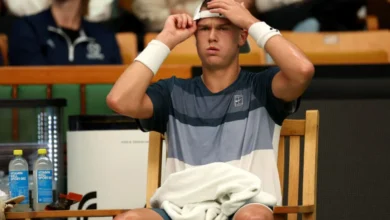

In the high-stakes arena of professional tennis, where every swing of the racket can propel a career to new heights or send it tumbling into uncertainty, few moments are as raw and revealing as Holger Rune’s recent brush with fragility. The 22-year-old Danish phenom, once hailed as the next big thing with a top-10 pedigree and a fearless demeanor that echoed the greats, found himself sidelined in the most abrupt way imaginable. A ruptured Achilles tendon—snapped mid-match during the Stockholm Open semifinals in October 2025—didn’t just end his season; it cracked open a window into the vulnerabilities of a young athlete who had, until that point, seemed invincible. In his first in-depth interview since the surgery, Rune delivered a confession that was equal parts heartbreaking and humbling: this injury “was not supposed to happen,” but perhaps, in its cruel twist, it was exactly what he needed to evolve.
The incident unfolded like a nightmare on the fast indoor courts of the BNP Paribas Nordic Open. Rune, leading Frenchman Ugo Humbert 6-4, 2-2, stretched for a routine point when agony seized him. He collapsed, clutching his ankle, tears streaming down his face as he whispered to the physio, “I heard something pop in my tendon.” The match was abandoned, and the diagnosis confirmed the worst: a complete rupture of the proximal Achilles, requiring immediate surgery. Just days later, Rune posted on Instagram, his words stark and unfiltered: “My Achilles is fully broken on the proximal part meaning I need surgery already next week.” The tennis world reeled—messages poured in from rivals like Novak Djokovic (“Get well soon, Holger. You’ve got this”) and Rafael Nadal, while peers such as Jack Draper and Taylor Fritz decried the grueling tour schedule as a ticking time bomb for young bodies.

Recovery has been a solitary grind, far removed from the roar of the crowds and the adrenaline of competition. Confined to a boot and a regimented rehab routine, Rune has shared glimpses of his progress: videos of one-legged squats, chest presses, and tentative walks that betray the fire still burning inside. But it’s in a candid sit-down with *Hard Court* magazine, published in mid-November 2025, where the Dane peels back the layers of bravado to reveal a profound self-reckoning. “Honestly, I think my injury was a shock for many tennis players and athletes because I never had an issue with my ankle, and my body was super healthy,” he began, his voice steady but laced with disbelief. Earlier that spring, after a bruising stretch of tournaments, Rune had subjected himself to exhaustive checkups—blood tests, MRIs, cell scans—all greenlighting him as “super strong,” free of inflammation or red flags. “So this was not supposed to happen—this should not be possible. I’m 22 years old, I’m healthy and strong, and yet it happened.”
That raw admission hung in the air, a testament to the surreal betrayal of a body that had carried him to upsets over Djokovic at 19, a Paris Masters title, and a career-high No. 4 ranking. Rune’s 2025 had been a rollercoaster: flashes of brilliance, like his gritty final against Carlos Alcaraz in Barcelona, interspersed with inconsistencies that saw him dip to No. 15 by season’s end. Yet, even in the wreckage, he refused to chalk it up to misfortune. “I don’t believe in being ‘unlucky’ or having ‘bad luck’ in sports. Everything happens for a reason, and there is an explanation behind everything.” Pinpointing fatigue as the culprit—”the main reason I got hurt”—Rune issued a stark warning to the sport he loves: “That is super scary for the whole sports industry.” It’s a sentiment echoed by his mother, Aneke Rune, who has publicly lambasted the ATP’s “obligatory” events and insufficient rest periods, though the Stockholm Open itself was a lucrative, non-mandatory stop.
What elevates Rune’s confession from mere lament to a pivotal turning point is his unflinching introspection about talent and complacency. The kid who burst onto the scene with a swagger that bordered on arrogance—declaring Grand Slam hunts and No. 1 ambitions at 19—now grapples with the cost of taking gifts for granted. “Maybe this is the slap in the face I needed to make me take my talent seriously,” he mused, the words landing like a gut punch. It’s a rare vulnerability from a player often critiqued for emotional volatility on court, the kind that led to meltdowns and mid-match retirements. This forced hiatus, projected to sideline him for 9-12 months and wipe out the early 2026 calendar, has become an unlikely classroom. “There were things before the injury I could improve on, so this is the time to list all of those out and work on them,” he said, crediting his family’s “positive mindset every single day” and his team’s structure for keeping despair at bay.
Fans and fellow pros have rallied around this newfound maturity. Social media buzzed with encouragement—posts of Rune’s smiling rehab sessions captioned “Step by step, keep going buddy”—while WTA star Ajla Tomljanovic, a veteran of her own Achilles and ACL battles, issued a gentle caution: “As someone who’s been through two ACL recos and an Achilles surgery, if I’d pushed this hard this early in rehab, I would’ve gone insane.” Rune’s intensity, even in recovery, underscores his relentless drive; one video showed him grinding through weighted exercises just weeks post-op, prompting divided reactions from “This is good for him actually” to “Someone lock him up for his own good.” Yet, beneath the humor lies admiration for a fighter unwilling to let adversity define him.
As December 2025 draws to a close, with the off-season’s quiet introspection yielding to the new year’s frenzy, Rune’s horizon feels both daunting and ripe with possibility. He’ll miss the Australian Open, the clay swing, perhaps even Wimbledon—milestones that could have cemented his elite status. But in embracing the “slap,” he’s forging a narrative of resilience, one that could transform a prodigy into a champion. Tennis, after all, rewards not just the swift and the strong, but those who rise wiser from the fall. For Holger Rune, this injury that “was not supposed to happen” might just be the forge that tempers his talent into something unbreakable. When he returns—fiercer, more grounded—the tour will feel his absence no more.