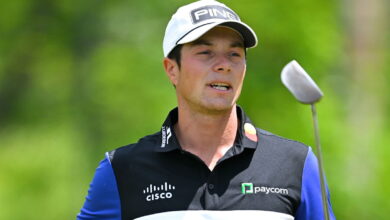

Viktor Hovland’s 2023 season culminated in one of the most dominant runs in recent PGA Tour history. Back-to-back victories at the BMW Championship—capped by a stunning final-round 61—and the Tour Championship secured him the FedEx Cup and an $18 million prize. Fresh off a starring role in Europe’s Ryder Cup triumph, Hovland appeared unstoppable, a rising force poised to challenge for majors and the world No. 1 ranking. Yet beneath the celebrations, a quiet unease simmered. Even at his peak, Hovland felt his game was fragile, held together by temporary fixes rather than a foundation built to last.
The Norwegian’s ball-striking had long been elite, but inconsistencies plagued him, particularly with his driver and irons under pressure. He relied heavily on a fade, but toward the end of 2023, he struggled to control it reliably. Bad habits had crept in during the grind of a demanding schedule, leaving him spending hours on the range after rounds just to patch things together. “I was surprised that I was able to win the FedEx Cup,” Hovland later admitted, revealing that his success masked deeper concerns. He knew changes were needed to compete at the highest level long-term, especially in majors where precision is unforgiving.



In the offseason, Hovland made a bold decision: overhaul his swing. He parted ways with coach Joe Mayo—who had transformed his short game—and sought to incorporate more draw-biased elements. The goal was noble—to gain versatility, reduce injury risk, and eliminate weaknesses—but the execution proved disastrous. What followed was a year of profound struggle in 2024, marked by missed cuts, coaching carousel, and a stark drop in performance. Hovland’s once-reliable swing abandoned him, leading to frustration and doubt.
The confession came amid this slump: “Right now, I feel so lost, I don’t see a way out.” Spoken to those close to him, it captured the vulnerability of a player who had scaled the heights only to plummet. Hovland cycled through instructors, experimented endlessly, and grappled with the mental toll of poor results. His season yielded no wins, few top-10s, and a world ranking slide. “I made a poor decision,” he reflected in early 2025, acknowledging the swing changes as the root cause. “Shit happens. That’s the game of golf.”
Yet Hovland’s story is one of resilience. The tinkerer who once scoured the internet for tips refused to accept mediocrity. By 2025, glimpses of recovery emerged—strong showings in select events and a renewed sense of direction. His pursuit of perfection, the same drive that led to the overhaul, fueled his comeback. Hovland’s scary admission of feeling lost humanizes the pursuit of greatness in golf, where even champions must confront uncertainty. In sharing his lows, he reminds us that true growth often emerges from the darkest doubts, paving the way for a stronger return.