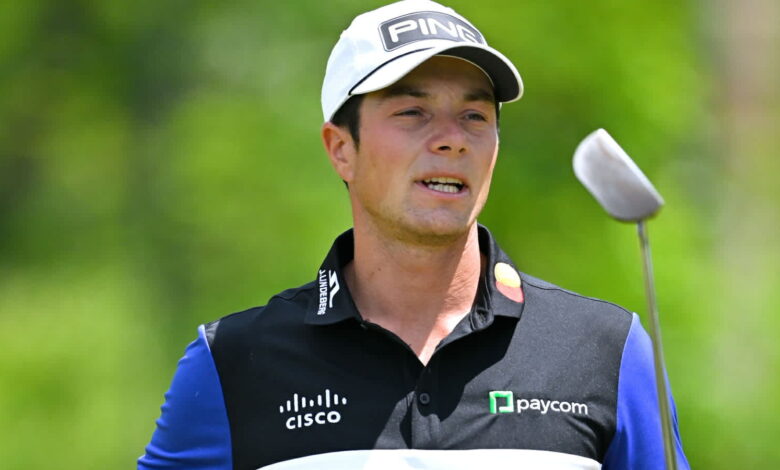
Viktor Hovland’s 2025 Ryder Cup experience ended in heartbreak, not with a dramatic putt or a celebratory roar, but with a painful withdrawal that left the Norwegian star sidelined and questioning his contribution to Team Europe. What began as a promising week at Bethpage Black—where Europe dominated early—turned into a personal ordeal when a recurring neck injury flared up, forcing Hovland out of the Sunday singles. The decision invoked the controversial “Envelope Rule,” sparking debate, but for Hovland, the real pain was emotional: feeling like he had let down his teammates in their quest to retain the Cup.
The injury wasn’t new. Hovland had been managing a neck issue since June 2025, which previously forced him to withdraw from the Travelers Championship. It resurfaced during Saturday’s foursomes, limiting his movement and benching him for the afternoon fourballs. An MRI that night revealed a bulging disc—a flare-up that worsened overnight. By Sunday morning, Hovland woke unable to rotate or flex his neck properly, making competitive golf impossible. Despite attempting to warm up, he informed captain Luke Donald he couldn’t compete.



“There is nothing more I would like to do than be out there representing Team Europe and trying to help them win the Ryder Cup today,” Hovland said in a statement at the time. “Not being able to do so is pretty heartbreaking.” Weeks later, reflecting on the moment, he described the entire situation as “pretty upsetting”—not just for himself, but for American Harris English, who was also forced to sit out under the rule.
The “Envelope Rule,” in place since 1979, ensures fairness in injury cases: each captain secretly names one player who would be excluded if the opposing team has a withdrawal. The affected match is halved, awarding half a point to each side. Hovland’s absence against English pushed Europe’s lead to 12-5 before singles began, meaning they needed just two more points from the remaining 11 matches to secure victory. As the U.S. mounted a fierce comeback, that half-point loomed large, drawing criticism from American captain Keegan Bradley, who called for the rule to change.
Hovland, however, defended it. “I think in the spirit of the Ryder Cup, and the spirit of the game and the history of it… it’s more of a gentleman’s agreement,” he explained in post-event interviews. Changing it, he argued, could open the door to manipulation. Yet the personal toll was undeniable. Limited to just three matches (going 1-1-1), Hovland felt the weight of unmet expectations. His massive putt on Saturday morning had been a highlight, but missing the climax left a void.
In the end, Europe clinched a 15-13 win, holding off the American charge. Hovland took time off to recover, avoiding clubs for over a week, but returned stronger in mindset. His story underscores the brutal reality of professional golf: even elite players like Hovland, known for their resilience and precision, are vulnerable to the body’s betrayals. The withdrawal wasn’t a choice—it was necessity—but the guilt of feeling he let his team down revealed the deeper human side of one of golf’s brightest stars. In confronting that pain, Hovland not only highlighted the Ryder Cup’s unique spirit but also reaffirmed his commitment to the battles ahead.