“Something Has to Change”: Viktor Hovland’s Candid Reflections Fuel Speculation on His Golf Future

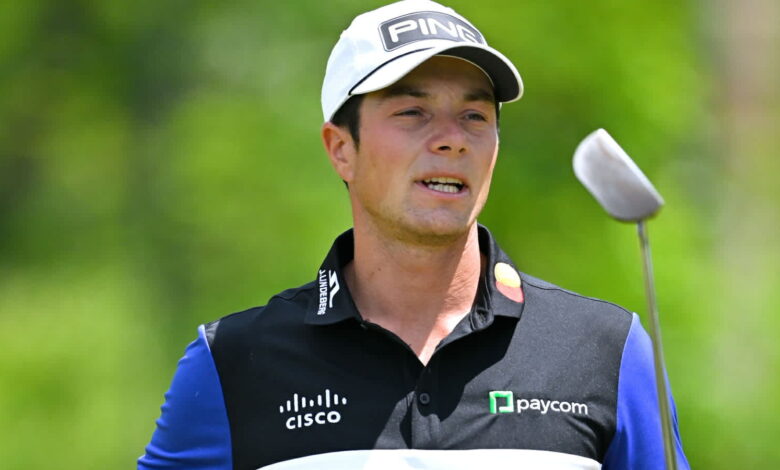
Viktor Hovland has never been one to mince words. The Norwegian golfer, once the talk of the sport for his meteoric rise to FedEx Cup champion and consistent major contention, has spent recent years navigating a series of swing experiments, confidence struggles, and public moments of raw honesty. While he hasn’t uttered the exact phrase “Something Has to Change” in a headline-grabbing 2026 interview, his ongoing commentary—marked by blunt admissions of “poor decisions,” evolving swing feels, and pointed critiques of the PGA Tour—continues to spark widespread speculation about what might come next for his career.
At 28, Hovland remains in his athletic prime, yet the past couple of seasons have tested his resilience. After a breakthrough victory at the 2025 Valspar Championship that seemed to validate his relentless pursuit of perfection, he has faced renewed challenges. Recent outings, including a solid 2-under 69 at the Genesis Invitational in February 2026 at Riviera Country Club, showed promising signs. Hovland highlighted improved ball-striking and driver confidence, describing the round as “a huge step in the right direction” even if “we’re not quite all there yet.” He experimented with creative drills—like resistance bands to create space in his swing and earlier pool floaties—to address pulling his arms too aggressively, a tweak he jokingly called himself a “genius” for discovering.


These glimpses of progress contrast with earlier frustrations. Hovland has openly discussed how adding draw elements to his naturally fading swing led to overcompensation and inconsistency. “Sh-t happens,” he remarked in a 2025 interview, admitting a “poor decision” in chasing changes that didn’t fully pan out. “It’s hard to play golf 20 years great,” he added, framing his journey as part of the sport’s unforgiving evolution rather than a deliberate spiral.
Beyond technical woes, Hovland’s candor extends to the broader landscape of professional golf. In early 2026, he didn’t hold back on the PGA Tour’s handling of LIV Golf returnees like Brooks Koepka and Patrick Reed. Calling the relaxed reintegration rules a “dangerous precedent” and questioning “What are we doing?!”, he highlighted the “tricky position” the Tour had created. Such outspokenness from a player long seen as loyal to the PGA Tour has led some observers to wonder if underlying frustrations could prompt bigger decisions down the line—though no evidence suggests a shift to LIV or elsewhere.
Physical setbacks have added layers to the narrative. A neck injury forced his withdrawal from the 2025 Ryder Cup singles, a heartbreaking moment that left him unable to compete despite his desire to represent Europe. Combined with short-game struggles and periodic missed cuts, these episodes have amplified fan and analyst theories: Is another coaching change on the horizon? Could a temporary break help reset? Or might Hovland prioritize different aspects of the game amid the Tour’s ongoing political turbulence?
Hovland’s personality—dry humor, occasional sarcasm (like his “SMH” Instagram reaction to new trees planted at Riviera to curb his creative line on the 15th hole), and unfiltered insights—only intensifies the intrigue. Unlike more guarded stars, he provides the kind of transparent soundbites that invite projection and debate.
Yet for all the speculation, Hovland’s track record suggests resilience. He has bounced back before, turning doubt into contention and even major-caliber performances. At his best, his ball-striking remains elite, and his willingness to confront discomfort head-on could be the very catalyst for the next breakthrough.
In elite golf, where fine margins separate champions from also-rans, the sentiment that “something has to change” resonates deeply. For Hovland, it may simply mean refining the tweaks already underway, regaining unshakable belief, or navigating the sport’s evolving dynamics. Whether it leads to another Tour win, a first major, or an unexpected pivot, his journey continues to captivate. The question isn’t if change will come—it’s what form it will take, and how spectacularly Hovland might rise again when it does.