
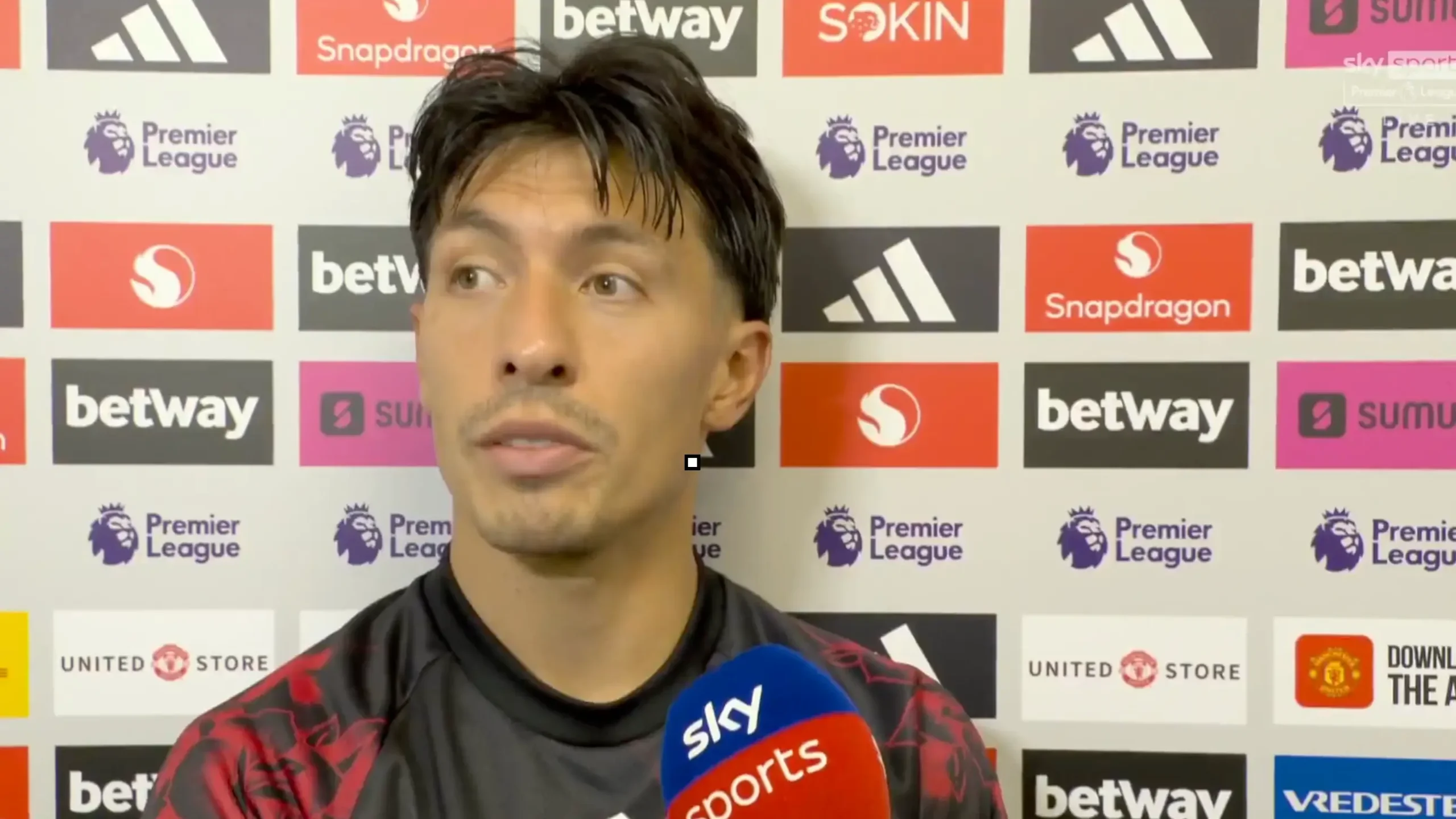
Manchester United’s disastrous afternoon at Stamford Bridge has taken another dramatic turn, with Lisandro Martínez’s dismissal becoming the centre of an increasingly heated debate surrounding the club.
The Argentine defender was sent off during the second half of United’s 2–0 defeat against Chelsea, leaving his teammates with an enormous challenge and giving the home side an opportunity to extend their advantage.
Cole Palmer subsequently converted the resulting penalty, putting Chelsea in a commanding position and leaving Manchester United with another painful defeat.
But while supporters have been debating whether Martínez deserved his red card, another question has emerged: was the Argentine defender left exposed by the players around him?
A sensational statement circulating online claims Martínez has privately expressed frustration with a teammate, accusing him of failing to track back and leaving him repeatedly responsible for covering defensive spaces.
The same viral statement allegedly places responsibility on Michael Carrick, accusing the manager of continuing to favour a player despite concerns about his defensive contribution.
There is currently no reliable confirmation that Martínez made those comments. Neither has he publicly confirmed a dressing-room confrontation with a teammate following the Chelsea defeat.
Nevertheless, the incident has reopened an important discussion about Manchester United’s defensive organisation and the responsibilities of the players operating in front of their back line.
Martínez’s Red Card Changes Everything at Stamford Bridge
The dismissal was one of the defining moments of United’s afternoon.
Before the incident, Carrick’s team were already struggling to find a way back into the contest.
Chelsea had taken the lead through Morgan Rogers, while United had seen an attacking effort from Matheus Cunha ruled out for offside.
The visitors needed a strong response, but Martínez’s dismissal made the situation considerably more difficult.
The Argentine defender was involved in an aerial challenge with Chelsea’s Jorrel Hato, and the referee judged the incident serious enough to show a red card.
United’s players were unhappy with the decision, but the dismissal stood.
Chelsea were subsequently awarded a penalty, which Palmer converted to make it 2–0.
For Martínez, it was an afternoon he would undoubtedly want to forget.
For Carrick, it was another major setback in a period when his managerial position was already attracting intense scrutiny.
The Alleged Teammate Disagreement
The most controversial part of the circulating statement concerns Martínez’s supposed frustration with an unnamed teammate.
According to the unverified comments, the defender believes he has repeatedly been forced to cover additional defensive spaces because of another player’s failure to track back.
The alleged criticism centres on defensive responsibility.
Modern football requires midfielders and attacking players to contribute when their team loses possession. When one player fails to recover, another teammate may be forced to leave his position to cover the space.
That can create defensive problems, particularly when a team is already struggling with its organisation.
Centre-backs are often left facing difficult situations when the midfield protection in front of them disappears.
However, it would be unfair to conclude that an unidentified teammate caused Martínez’s dismissal without evidence.
The defender was responsible for his own challenge, regardless of any wider tactical or defensive problems.
There is also no verified evidence that he confronted a teammate or accused someone of disrespect after the match.
Why Carrick Is Facing Questions About United’s Defensive Structure
The criticism surrounding Carrick is becoming increasingly difficult to ignore.
Manchester United have struggled to maintain defensive consistency, and the Chelsea defeat exposed several problems that cannot simply be attributed to one player’s mistake.
The team’s defensive shape, midfield protection and ability to recover possession have all come under scrutiny.
A manager must ensure that players understand their responsibilities, particularly when the opposition begins attacking through dangerous spaces.
If midfielders fail to provide sufficient protection, the defenders can become exposed.
If full-backs push forward without adequate cover, the centre-backs may be forced to defend larger spaces.
And if the team loses its structure during transitions, even experienced defenders can find themselves facing difficult situations.
These are tactical problems that require collective solutions.
Carrick must therefore find a way to improve United’s organisation rather than allowing individual mistakes to become repeated weaknesses.
The Slow Favourite Player Allegation
Another particularly explosive element of the viral statement is the suggestion that Carrick continues to favour a player despite concerns about his pace and defensive contribution.
The alleged comments have generated speculation about which Manchester United footballer Martínez could have been referring to.
However, the statement does not identify the player, and there is no reliable evidence connecting any specific teammate to the accusation.
It would be irresponsible to attach the allegation to a particular United star without confirmation.
What can be discussed is the wider tactical issue.
Manchester United need players who understand when to attack, when to recover and when to protect their teammates.
A midfielder who contributes significantly in possession may still need to improve his defensive positioning.
Likewise, an attacking player cannot be judged solely on goals and assists if his movement without the ball leaves the team exposed.
Carrick must find the right balance between attacking quality and defensive responsibility.
Martínez Must Also Accept Responsibility
Although the wider defensive structure deserves examination, Martínez cannot completely escape responsibility for his dismissal.
Professional football is a game of decisions, and defenders must understand the risks involved when challenging opponents.
A centre-back who commits a foul in a dangerous situation can leave his team exposed, regardless of what happened earlier in the move.
The Argentine is known for his aggressive approach, determination and willingness to compete physically.
Those characteristics have made him an important figure for Manchester United, but they also demand discipline.
His dismissal against Chelsea created another problem for a team already struggling for confidence.
The best response would be to learn from the incident, regain his place and help the club improve its defensive performances.
Blaming teammates without evidence would not solve the underlying problem.
Manchester United Cannot Afford a Dressing-Room Crisis
The last thing United need is another internal disagreement.
The club has experienced several difficult rebuilding periods, and instability has repeatedly made it harder for managers to establish a consistent team.
If players begin questioning one another’s commitment, the consequences could extend beyond individual performances.
Trust is essential in football.
Defenders need to trust their midfielders to provide protection. Midfielders need to trust their attacking teammates to contribute defensively. And everyone must understand the manager’s tactical instructions.
Without that collective understanding, even talented squads can struggle.
Carrick must ensure that frustrations following the Chelsea defeat do not develop into a larger dressing-room problem.
The immediate priority is restoring confidence, improving defensive discipline and getting results.
Carrick Faces an Important Test
Manchester United’s defeat against Chelsea has increased the pressure surrounding Carrick’s future.
Nine consecutive matches without a victory is a worrying sequence for a club with United’s ambitions.
The manager must now demonstrate that he can organise the team, improve performances and restore belief among supporters.
The Martínez incident may eventually become just another controversial moment in a difficult season.
But if United continue conceding goals, losing matches and struggling with defensive organisation, questions about the manager and the club’s football leadership will only become louder.
For now, there is no confirmed dressing-room confrontation involving Martínez, no verified attack on an unnamed teammate and no evidence that the defender publicly blamed Carrick.